
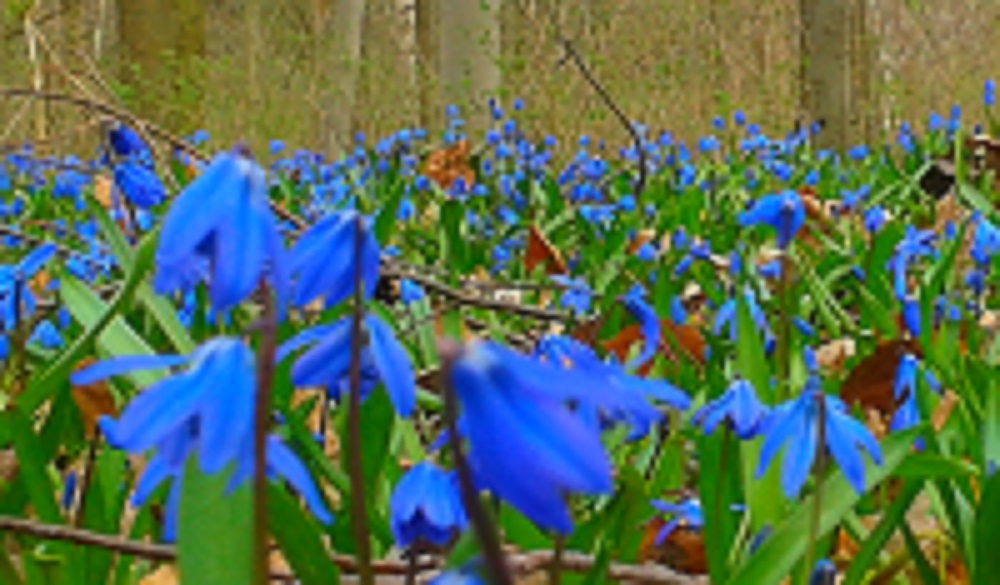
It’s cold out here; the first day I have really started writing on the island. Even with the sun, it still feels like winter. No flowers, no greenery, just me and the buds of the magnolia. Although I did notice two glory-of-the-snow flowers have sprouted up in front of Manfred’s house, tiny reminders that spring is still coming. They are always the first to appear, those blue flowers. Exciting little things, I wonder if they were always that color. Their hue is beautiful, and very unique. Supposedly they are purple, but to my eye, against the brown of spring, they appear vividly, unmistakably blue.
The last primary color that humans came to see was the color blue. That may seem a bit ridiculous to think about, as two of the largest swaths of color we see are blue – the sky and the sea. Yet if one were to look at water, it is rarely just blue, but a mix of colors and reflections that could never be described as simply blue.
And the sky, well, the sky is definitely blue. But how we identify the sky is culturally specific.
If we were to think about language as deterministic, then humans would only be able to experience blue after it was named. In Greek, there was no word for blue. In fact, many languages historically were missing a name for the color in their lexicons. One theory is that we do not have nomenclature for a color until we can produce it ourselves. That was why the ancient Egyptians had a term for blue – due to their ability to produce indigo – while the Greeks did not. Yet at one point humans became acutely aware of blue. In fact, Alexander von Humboldt in the early 1800s used to carry around a machine called the cyanometer to measure the blueness of the sky at different elevations. So could Humboldt see colors that others could not? The truth is that all colors are relational. There is no objective color blue. We learn to distinguish between colors when we need to distinguish between them. One scientist tried this idea out on his daughter. From a very young age, he would ask her intermittently what color certain objects were. When he would ask her what color the sky was, she had no response. If she did come up with an answer, she would describe it as white. As she grew a little older she started to say the sky was blue. So did that mean that she could not see the color blue until someone told her?
Probably not. What that most likely meant was that there was no reason or her to identify the sky as blue. Also, her reference to the sky as white had more to do with thinking about the sky as neutral, like how painters prepare a canvass with a different color before they begin to paint. Yet that may mean that she must first develop a palette of shades to understand the intricacies of a color. For Humboldt, the color blue was important to him, therefore I would imagine he could see many more shades in the sky than I could. Blue is a shared reality in which individuals experience colors differently, but can identify the same color in relation to others. Therefore mine and Humboldt’s blue are probably quite different, yet we would both identify the same swatch in a lineup. For reality to be shared, we all have to agree on certain preconditions. Today, that precondition is that the sky is blue, whatever that blue happens to be. Therefore we teach children to identify that same blue so our world stays the same.
Friends of mine just had a child. She is beautiful. All she does is roll those crystalline eyes, stretches, feeds, takes a dump, and then sleeps. Her father Paul informed me that the looks that she gives us – while meaningful to her admirers – are very confusing to her at just a couple of weeks old. This is because her brain does not discern different sensory inputs. All of them exist at once to her. As she grows, she will learn to distinguish between images and sounds, textures and smells. But at the moment, it is one jumble of information coming at her. How she will learn to distinguish between different inputs has to do with what she will need to get by. As she grows up, she will glean all kinds of exciting skills, and in the process, learn how to categorize her sensory experiences. She will also learn that the sky is not white, or neutral, but blue, whatever that blue is to her. And when she sees those first crocuses appearing out of the ground, she will be able to identify and contextualize them the way that we learn to do so – as a shared blue, and the beginning of her next spring.
If you’re interested, listen to this podcast about the color blue throughout history. It’s good.
 Bodies of Water
Hey Jeff! Sorry it took me a minute to write back. I’m still figuring out this whole wordpress thing. As for blue, I’m not sure if it’s a question of visibility, as much as cultural designation. Since our eyes have probably not evolved too much over the past few millennia, I think it has more to do with whether we choose to identify blue as its own separate canon of shades. And interesting you bring up violet, as that led me into thinking about purple. Take a look at this video I found. It has one of the best lines I’ve heard in a while: magenta is the absence of green. https://www.youtube.com/watch?v=iPPYGJjKVco
LikeLike
Blue has a very high frequency compared to most other colors in the visible spectrum (only violet is above, which as you say is often perceived as blue), and the human eye perceives frequencies of light with different cones. The cone which can perceive the highest frequencies is also our least sensitive, so do you think that may have to do with it being one of the last colors to be identified? I’m curious if violet was also a color that was identified later too.
LikeLike