
The last time I was in Chilliwack, British Columbia I was amazed. It had been a long time since I was in Canada during summer, and it was nice to see the Fraser Valley in all its glory. What struck me was the peculiar shape of the valley. It is completely flat, an elevation not much higher than sea level, but rimmed by towering mountains which can carry snow all year round. Just north of a rainforest, runoff from those mountains can be substantial, and my grandmother lives in the very center of where the water would flow.
Yet her house does not flood. This is possible through systems of dikes and locks that hold the water behind quiet walls and troughs that let the blueberries grow and tell the fish where to swim. They allow roads to remain passable and the land accessible for every growing season. No one builds on stilts in the valley; no one conforms to the land’s ebbs and flows. The land is rich and they want it year-round; they need that soft sediment and those minerals that move through the undulating water line. It is how they grow our food, and how a built environment becomes the norm.
The flood plains of the valley are more a memory, with over 600 kilometers of dikes, 4,000 flood boxes, and a litany of pumps that maintain the Fraser River at a manageable size. It is designed to move the mountain runoff at a relatively stable rate while keeping the land both arable and accessible – a tricky balance.
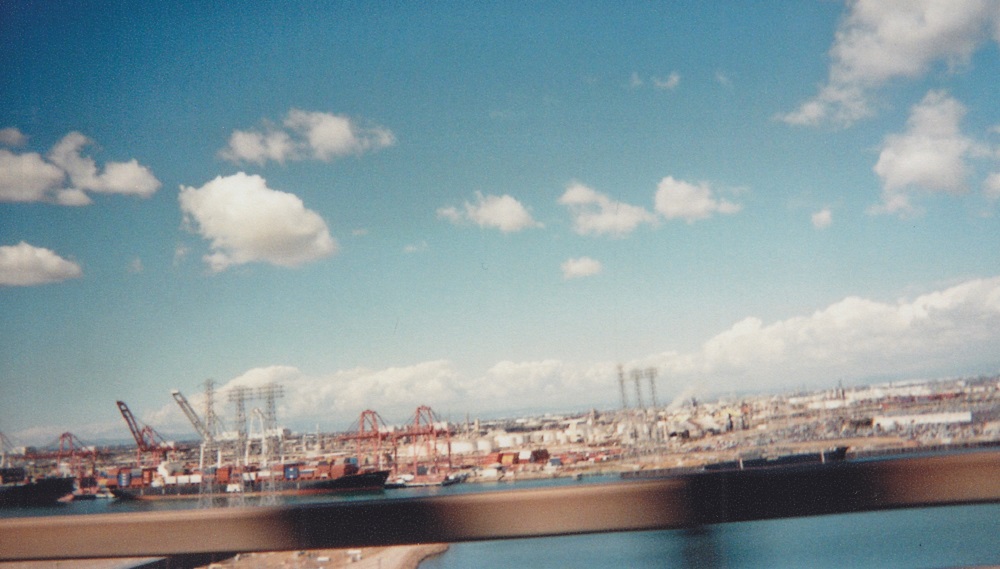
At the other end of the West Coast spectrum, the great behemoth of Los Angeles tried their hand at something similar, but with a different approach. They attempted to take a desert – which relies on a period of floods followed by long periods of drought – and remove its tidal propensity. They did this by taking a river, and turning it into a cement chute.
Despite the concrete bed and lack of water, the Los Angeles River is a river. Control of the water is necessary for the city itself to function. The river, which was more a stream for most of the year, had a tendency to erratically change course every decade or so when it flooded, infusing the land with much-needed nutrients. The burgeoning city tried a few approaches to direct its meandering power. The ultimate expression of control happened in the 1940s, when development forced the city to change the ambling stream into a massive gutter, direct and unbending. It was unceremoniously designated a “flood control channel,” part of the 450 miles of paved channels in the county. The idea was to stop all flooding, so that the city would have the capacity to grow exponentially. Most of the year, the cement of the Los Angeles River remains dry. The water now runs as a tiny trickle through its cement trough, a reminder of what used to be.
Over the years, the advent of the flood control channel has led to the land around the Los Angeles “River” to become so developed that there is very little ground without pavement. This has stopped the water from penetrating the soil and making its way eventually to the sea. Instead, the water forms in puddles around the lowest curbs, forcing the heaving city to slow. The city quiets when it rains. The already diminished movement on the freeways stutters even further, and the pools of water found on street corners take on a type of metallic sheen, catching the run-off oil from the congested streets. I know it is supposed to be ugly, that oily film, but it is only with prior knowledge that it gains its sinister hue. If one forgets, just for a moment, that it does not gain its sheen from the miscegenation of water and petroleum, it takes on a celestial quality, like the arm of a galaxy seen through the Hubble telescope. In actuality, the oily film is simply a little reminder of commodities traded in the Middle East or South America, refined somewhere else, and eventually sent to the end of the continent – Los Angeles.
Mike Davis describes postmodern cities as the final destination of goods. Things are not made in cities any longer; they are areas of service. As “Western” cities become less production-based in their industries, they change into areas of consumption, a kind of end point to a long line of production, transportation, capitalization, and exploitation, until the shell of what remains loses its purpose and must be discarded. It is in cities that everything collects – refuse and broken cars find themselves in poorer neighborhoods and underneath freeway onramps. Parking lots for defunct businesses become the final resting places for all things that cannot find their way back into the machinations of capital. In these old parking lots and sinking street corners, this is where water used to soak into the soil. It was here that the carrying capacity of the land was tenable, even abundant, not unlike the Fraser Valley today. Now it is dominated by flat, uncommunicative asphalt, unable to accept the water that used to replenish the parched landscape. A harsh reality, perhaps necessary in a world of ever-increasing population.
It is only in those puddles where galaxies collect that one can see the remnants of the drought-flood cycle that once defined the region. The flood control channel’s pathway is predetermined, the runoff destined to find its way to the ocean once more. The areas of the Fraser Valley and Los Angeles, ecologies of similar size, stand as two opposites dealing with a single question: how can we access the land we need? One is needed for production, the other for consumption. Each vastly different, they stay as built environments, allowing us to exist with a population much higher than its traditional carrying capacity. Therefore I view each environment as part and parcel with the current shape of the world. Both valleys are realities; both are parts of our starry polarity.
 Bodies of Water