
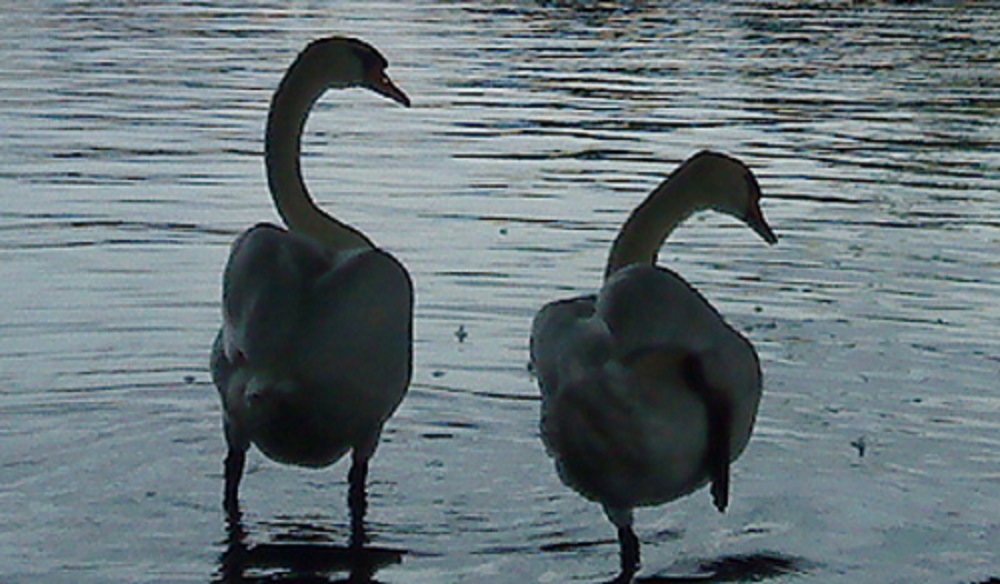
I’ve been thoroughly enjoying our new round of winged visitors. This time it is a group of swans. Normally, swans can be a little aggressive. Yet these aviators I find respectful, disinterested, and generally a nice addition to the area, as they are charming to see on the water. On top of it all, they do this weird thing with their feet where they swing one of their big purple webs of talons up above their body, so it rests in the sun. It lays uselessly on their feathers, like the bird equivalent of Kaiser Wilhelm II’s left arm. When watching these big creatures, they display all kinds of strange traits. As they make their semi-consistent forays around the island, some of them want to move in close and see what you have. Others just hiss as if you were the one who approached them. Others stay far away from anything human. Most would agree that swans – like dogs, cats, and sasquatches – have personalities. We can watch their different motives, and understand that there is also a swan society. They are always testing each other, fighting for mates, food, and position within the group. They can be generous and tricky, kind and cruel. Yet this behavior is always interpreted by human standards.
I once saw a group of swans being fed giant loaves of bread by two old Turkish women down by the canal in Kreuzberg. They threw in loaf after loaf of bread, not tearing the units into smaller chunks, but simply tossing bread in full half-kilo forms into the water. This attracted every single swan from the area to the patch of canal directly in front of us, creating what can only be described as a feeding frenzy. They were not fighting over crumbs; there were kilos of sweet carbohydrates on the line. Their bills were flying at each other, and the pecking order was soon established, with the most powerful in the middle. Yet the most dominant were not necessarily the biggest. The ones on the outside tended to be seem meeker, waiting patiently on the fringes, as little white pieces of fluff found their way out of the middle chaos and into the surrounding water.
Then there was a slightly smaller swan who arrived a little late on the scene. It wanted to get into the action. Most of the swans were jockeying for position, finding their place within the group, and using their beak as fast as they could to pick up as many chunks of bread as swan-ly possible. Yet this particular fowl was going straight for the other birds. It had pushed in from the outside, infiltrating the outer ring of swans without much issue, nipping at their feathers and necks so that they relinquished their position. This pushy swan was able to create a small circle within the mass of birds to collect the white gold. But this animal grew increasingly brazen, starting to snap at more and more of the birds, until finally it snapped at the wrong one. It grabbed the tail of what I can only assume was the swan chieftain, who turned around and gave one very serious and stern hiss, which sent the young upstart reeling in fear. At that point, the young upstart reeled back to compete with the outer ring, contenting itself to be the strongest of the weak, not able to breach the inner circle of breadwinners.
Suarez, as I called this upstart, clearly has a personality. We can document the intent of its movement, and, by observing the actions of other swans, we can start to understand the basic tenets of swan life. We will never understand the interiority of a swan, how a swan thinks, its values. But to be honest, we cannot even do that with other humans. Yet thought and behavior are really two sides of the same coin, different yet inseparable from each other. Watching swans shows us about swan life, even if we have to pass it through our own lens.
The problem lies in how we interpret the swan. As observers, we make personal judgments about that swan based off our own values. I would consider Suarez, like the human version, kind of a dick. The reason is because aggressive behavior is viewed as a negative attribute within a society. Yet this is assuming that everyone is receiving their fair share. In Germany, no one is starving; no one is fighting for their life. Therefore, to act aggressively is seen as greedy or selfish. It shows poor character, and a lack of respect for those around us. Although in other situations the same qualities might be lauded. In the case of the human Suarez, he can slide tackle, push, and shove his opponent up to a point, but he cannot bite. When he does, he breaks a social contract that he has agreed to.
Yet swans are not soccer players, nor do they receive social benefits, nor do we fully understand the processes that create the inner and outer circle. It is a species divide that we perhaps will never really be able to cross. We can only stand at the shore and throw loaves of yesterday’s bread into the water, favoring the strong in the middle playing by the rules, for winning according to the values that seem most like our own.
 Bodies of Water