
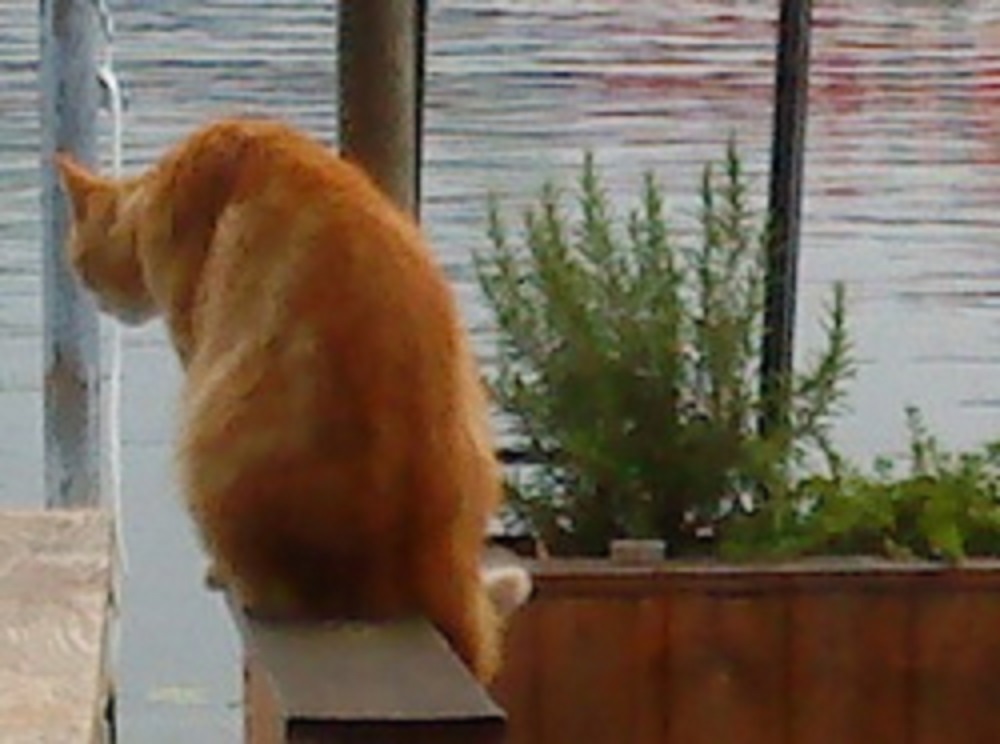
For the first time in two years, we have a new roommate on the island. Beyond Neil, Laila, and yours truly, a mouse has taken residence in the cabin. It was something I always assumed would happen, but have been able to avoid it up until this point. This has nothing to do with our house, which is far from impervious. The lack of rodents is rather related to the excess of cats. The island has five cats. Three are part of Manfred’s household, while the fourth is a big white street cat from Tel Aviv who stares at me with oriental eyes from her cabin. And the fifth is Ruda. Ruda is my favorite. She controls about half the island, as the other four fight for space in the corners. She is fed by Sophia and Irene, and is surely fond of them, but mostly considers herself the one in charge. She is a big orange tabby, with beautiful markings and a heart of pure evil – the way I like my cats.
Ruda is a huntress as well, making rounds of her half of the island. She has her territory, and tends to keep her distance from Manfred’s house, knowing she might come in conflict with the other felines on the island. Yet our porch is definitely under her domain. If I am outside reading, she might stop by. If I am using power tools, you better bet she is going to be there, climbing over everything I am trying to sand or drill, like the worst site supervisor of all time.
Yet Sophia and Irene have been out of town for the past couple of months, vacationing in warmer climes. Therefore Ruda, and the small squirrel sanctuary they are harboring in their house have been moved to Sophia’s mother’s house in Berlin. I am sure Ruda is ready to get back to the island – at least I am.
Partly I miss that orange beast. She is as funny as she is cruel, and at the moment, I am in need of both her company and her remorselessness. The advent of the new roommate – or roommates – causes a minor issue in the way I imagine my household. I am happy to share my space with the rest of the animal kingdom. Correction: I am happy to share my outdoor space with animals. Indoors is for humans only – and their feline overlord.
Yet without the killer, I do not know what to do. I have killed many mice in my life, and I would not say that I would like to repeat any off those experiences. I do not find myself prone to bloodshed, and although I like to imagine myself with a masculine streak to defend hearth and home from invasion, the reality is much different. Also, my resolve is weakened by the relative innocuousness of the trespasser. My killings have been of the mercy kind; I guess that was just how I was raised. I remember my old cat Bartina would sometimes capture a mouse and then release it in the house, just for shits and giggles. My mother would respond in the most stereotypical way possible by either climbing onto a chair and screaming bloody murder, or locking herself in the bathroom and screaming bloody murder. My father would then rush into the kitchen and put on two oven mitts, grab a set of barbecue tongs, then attempt to corner the mouse to be picked up with the exaggerated forceps and relocated outdoors. While this was happening, Bartina would be in pure ecstasy, cornering the mouse and then releasing it as soon as my father was in tonging-distance. The game would then go on and on – chairs, couches, and boxes all upset to locate the quarry. All the while, my mother would be giving instructions in a shrill pitch, echolocated from the bathroom. The chase would usually end with either the mouse escaping out of an open door, or Bartina growing bored with her game and finishing the kill. Growing up in the countryside, mice were a common occurrence in our household, yet we never figured out a better plan. We Bodines are not hunters.
Lacking any thirst for blood, I find myself at an impasse. I have no interest in personally killing the animal, yet I want it out of my life. So I am choosing the path of least resistance. In as much, I will allow the animal to nibble at the corners of my human food, its existence antithetical to my own view of my natural surroundings. I will not make any inroads toward the destruction of our mouse, yet I will not bat an eye when Ruda returns and cruelly tears the mouse apart for her own amusement – a Rancor let loose. I will think, that’s just nature, and banally return to my every day.
I can always claim that the blood is not on my hands. Donna Harraway writes that perhaps the problem with animal exploitation is not necessarily the act of killing – which she defines as inseparable from human existence – but the dissociative acts that allow for exploitation without reflection. We cannot all live as Jains do, walking around with masks and no shoes to avoid killing any creatures underfoot or under-breath. Instead, Harraway recommends that humans reestablish the connection between death of an animal and human’s relationship to it. Her philosophy is not to eliminate the animals as consumption, but more focus on creating an understanding of non-human interaction when it comes to viewing, eating, and owning animals. She suggests that perhaps instead of ‘thou shalt not kill’ as a mantra for animal-human relations, it should be ‘thou shalt not make killable.’ In this, she places the onus not on the consumption of the animal, but on the consumerism of its demise.
Good thing Ruda is a killer, with or without my consent.
 Bodies of Water